One piece you genuinely love in a room changes the quality of everything else there, because it gives the eye and the heart a place to anchor.
Most home decorating fails not because of what’s present but because nothing in the room was chosen with real feeling.
You don’t need a fully designed room to benefit from this. One right piece is the beginning.
Silver Fox Gallery on North Main Street in Hendersonville carries original art and handmade objects worth loving across a wide range of prices.
There’s a difference between a room that’s furnished and a room that has a soul. Walk into each and you feel it immediately. The furnished room has everything it’s supposed to have. The room with soul has something more: a focal point that pulls you in, a piece that says something true about the person who lives there, an object you keep coming back to. That something more is almost always a single piece someone loved enough to choose.
This isn’t a design philosophy requiring expertise or a large budget. It’s a very simple principle that changes how every room in your home feels: make sure each room has at least one thing you genuinely love.
What One Beloved Piece Does
It sounds too simple. But consider what actually happens when a room has a piece in it that you feel strongly about.
Your eye goes there first. Which means the room reads as organized and purposeful, even if it has plenty of imperfect elements. A focal piece does the work of making a room feel complete in a way that five okay pieces can’t.
You engage with the room differently. A room with something in it that you care about becomes a place you notice and inhabit consciously rather than just moving through. The morning coffee tastes a little better across from a painting you love. The evening is a little quieter in a chair near a piece of pottery that pleases you every time you see it.
And the rest of the room benefits. Things around a piece you love seem more intentional, because they’re being judged against something that was genuinely chosen. The plain white bowl near the beautiful ceramic piece looks deliberate. Without the beloved piece, the same bowl looks random.
Where This Principle Applies
In the Living Room
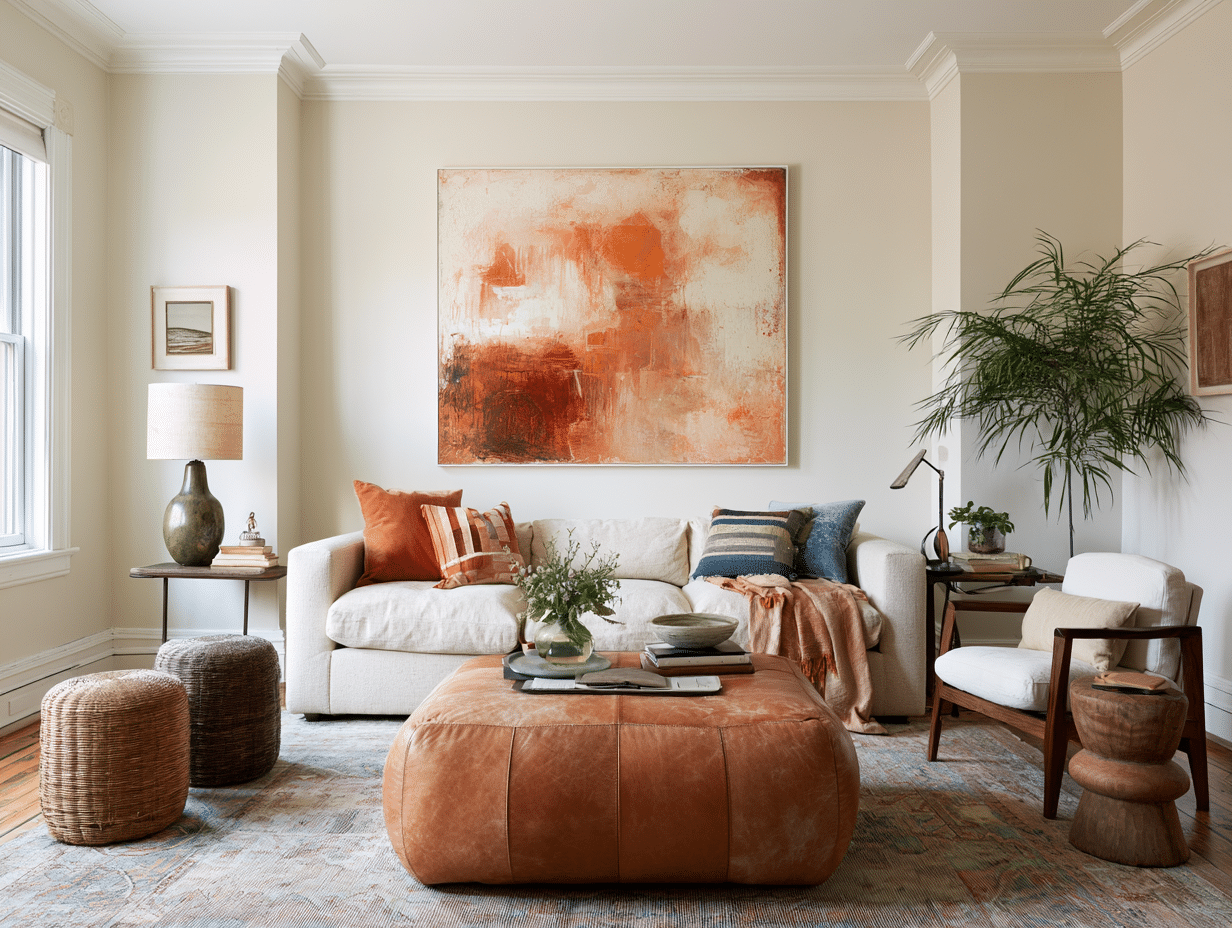
This is usually the room where people put the most thought, and still the room that often misses the mark. A living room with a good sofa, a fine rug, and a television is complete in a functional sense. Add a piece of original art that actually moves you, hung where you see it every day, and the room becomes a place rather than a setup.
The living room is also where guests spend most of their time, which means the piece you love there is the piece your home is most known by. Choose something that reflects what you actually value, not what you think a living room should have.
In the Bedroom
Most bedrooms are under-invested in compared to public rooms. Guests don’t see them, so the art and objects there get whatever was left over. But you see your bedroom every morning and every night. The case for having at least one piece you love there is stronger than in any public room: it’s the first and last thing you see in the day.
A single painting above the dresser, a handmade ceramic piece on the nightstand, a small original sculpture on a shelf: any of these can make a bedroom feel like a place you chose to sleep rather than a room with a bed in it.
In the Kitchen
Kitchens get a lot of attention through fixtures and finishes and almost none through art and handmade objects. Yet people spend enormous amounts of time there. A handmade pottery bowl on the counter. A small framed painting on the wall between cabinets. One piece of glass on the windowsill above the sink. These things do as much for the daily experience of a kitchen as a new backsplash does, and they’re usually considerably cheaper.
In the Rooms People Don’t Think About
Bathrooms. Hallways. Home offices. Mud rooms. These are the rooms that get the leftover, the things that didn’t quite fit somewhere else, or nothing at all. Each of them is a room you pass through or spend time in every day. One good piece in each of them changes the experience of the whole house, because every room in a home is part of the same experience.
How to Find That One Piece
This question matters more than it might seem. Most home furnishing advice is about what category of thing to buy: get a rug, hang art, add a lamp. The harder question is what specifically to choose within any category, and the answer requires honest self-knowledge.
Stop and think about what you respond to. What kind of art stops you? What objects do you find yourself returning to look at? What colors, materials, and forms feel right when you encounter them? These responses are your guide and they’re more reliable than any trend or recommendation.
The clearest way to find a piece you genuinely love is to be in front of physical objects, not screens. A gallery where you can hold pottery, stand in front of paintings, and move through the space at your own pace is where these responses reveal themselves most honestly. What stops you when you’re not trying to find a particular thing is usually the right guide.
Silver Fox Gallery in downtown Hendersonville is exactly this kind of place. Jennifer, the owner, has spent more than twenty years choosing work from regional and national makers, and it’s a no-pressure environment where you can browse for an hour and leave without buying a thing, knowing you’re welcome back. As she puts it, come feel what handmade really means. The feeling of being genuinely moved by a piece is the most reliable signal you have.
One Room at a Time Is Enough
You don’t need to solve every room at once. Start with the room you spend the most time in, or the one that bothers you most in its current state, and find one piece for it that you truly love. Live with that choice. Let it show you what it does for the room. Then move to the next.
A home built this way, one right choice per room over a period of years, ends up being more personal and more coherent than one decorated in a focused campaign. The pieces carry different stories and came from different moments, but they share the common thread of having been chosen by someone who cared about them.
Summary
Every room in a home deserves at least one piece that was chosen with genuine feeling, because that one piece gives the room a soul. It anchors the eye, lifts the things around it, and makes the room a place you inhabit rather than just pass through. The principle applies everywhere, living room, bedroom, kitchen, bathroom, and hallway. Find the piece by paying attention to what stops you in person, not by following trends. Build your home one right choice at a time, and each room will tell an honest story.
Frequently Asked Questions
Does this mean I need to throw out everything else in my rooms?
No. The principle is about addition, not replacement. One piece you genuinely love in a room changes the quality of what’s already there. You don’t need to clear everything out. You need to bring in one thing with enough meaning that the room has a center.
What if I can’t afford original art right now?
Start with a handmade object at a price that works for you. A piece of pottery, a handmade bowl, a ceramic piece that makes you smile when you see it: these cost much less than original paintings and do real work in a room. Silver Fox Gallery carries handmade objects at a wide range of prices with no minimum purchase.
How do I know if I truly love a piece or just think I should?
Trust the physical response. If a piece makes you stop, if you keep coming back to it, if you find yourself thinking about it after you’ve left the gallery, that’s genuine. If you’re choosing it because it seems right for the space or fits a category, that’s not the same feeling. The first response is the one worth following.
Can a handmade object count, or does it have to be art?
Absolutely. A piece of pottery you love, a handmade glass piece, a carved wood object, a beautiful ceramic vessel: any of these qualify completely. The question is whether you genuinely love it and whether it makes the room feel more alive. The category doesn’t matter as much as the quality of your response to it.
What if I have good pieces but none of them feel special?
That’s a signal to add one thing that does. You don’t need to replace what’s there. You need to bring in one piece with enough presence that everything else re-orients around it. Sometimes the right piece makes you realize the things already in the room were fine all along. They just needed something to anchor them.




Leave a Reply